

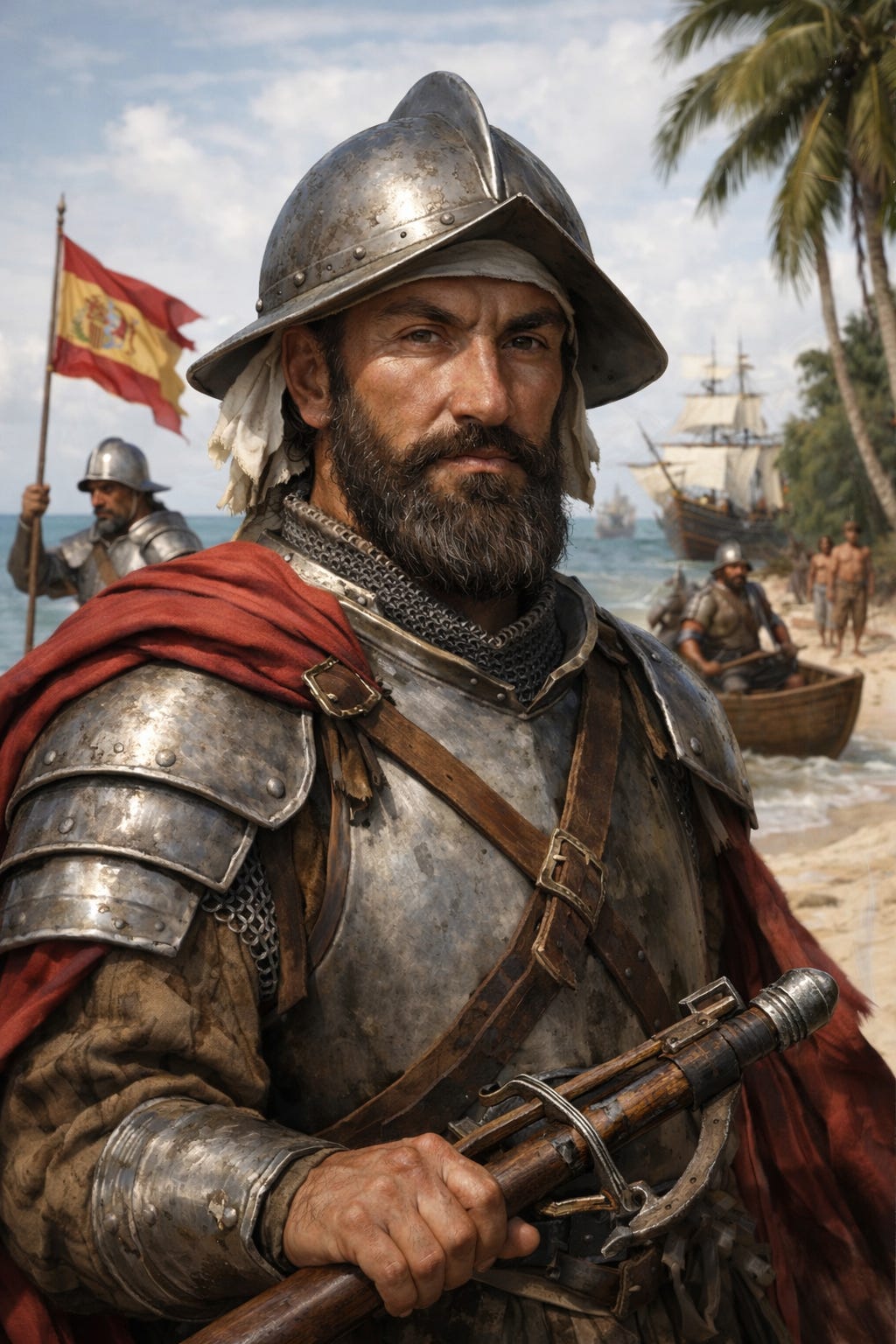
Image adapted by AI from a portrait of Cabeza available here.
Audible version of article:
The Journey of Álvar Núñez Cabeza de Vaca
A Narrative Based on His Testimony of 1542
Preface
Next year marks the 500th anniversary of one of the most extraordinary expeditions in the age of exploration. In June of 1527, six hundred Spanish conquistadors set sail from Spain under the command of Pánfilo de Narváez, bound for the unknown wilderness of La Florida. They carried with them the ambitions of empire: to conquer, to colonize, to claim gold and glory for Spain.
Nine years later, four men walked out of the wilderness.
Of the six hundred who departed, only four survived—and only one, Álvar Núñez Cabeza de Vaca, would write the story of what befell them. His account, La Relación, published in 1542, is a travel log like no other: the testimony of a conquistador who lost everything – his ships, his weapons, his armor, his companions, his very identity as a Spaniard – and was transformed by the loss.
What follows is his story, condensed and adapted by AI for modern readers. The facts, the places, the casualties, the strange customs, the miraculous healings – all are drawn from his original testimony and corroborated by historical research. Only the voice has been reshaped, to let a twenty-first century reader experience what a sixteenth-century survivor witnessed.
This is the story of Cabeza de Vaca: the conquistador who persevered, adapted, and ultimately survived.
Part One: The Burden of Miracles
They would not let us sleep.
Every night, hundreds of Indians surrounded our camp, bringing their sick and dying, their paralyzed and their blind. They brought infants still wet from birth. They brought old men carried on the backs of their sons. They came from villages we had never seen, having walked for days after hearing rumors of us – rumors that had spread across a land so vast I could scarcely comprehend it.
They called us “children of the sun.” They believed we had power over life and death.
We could not eat a morsel without first blessing it. We could not drink water without their permission. Every scrap of food, every piece of meat, every handful of roots – they would bring it before us, waiting with such expectation in their eyes that we dared not refuse. We would make the sign of the cross, breathe upon it, commend it to God our Lord, and only then would they consume it. Without our blessing, they left the food untouched, preferring starvation to eating something we had not sanctified.
Three thousand, sometimes four thousand people followed us at once. The sick came in such numbers that in three hours we could not finish attending to them all. My companions Castillo, Dorantes, and the Moor Estevanico had all become healers alongside me, yet still we were overwhelmed. The Indians pressed so close in their eagerness to touch us that we could scarcely breathe.
And the strangest part of all? The cures worked. God performed miracles through our hands that I cannot explain. The paralyzed rose and walked. The fevered cooled. A man I found with no pulse, his eyes rolled back, whom I believed to be dead—I prayed over him, made the sign of the cross, breathed upon him as was our custom. That night the Indians came to tell us he had risen from his bed, walked about, eaten, and spoken with them.
All over the land, nothing else was spoken of.
But that is not how it all started.
Part Two: The Unraveling
We left Spain with six hundred men, five ships, and the blessing of His Majesty. It was the 17th of June, in the year of our Lord 1527, and Pánfilo de Narváez had been granted authority to conquer and govern the provinces from the River of Palms to the Cape of Florida. I served as treasurer and chief constable – the King’s eyes and ears. We landed thirty-five years after Columbus discovered the New World. I was thirty–seven years old.
We were going to claim a new world for Spain.
Instead, we found a grave.
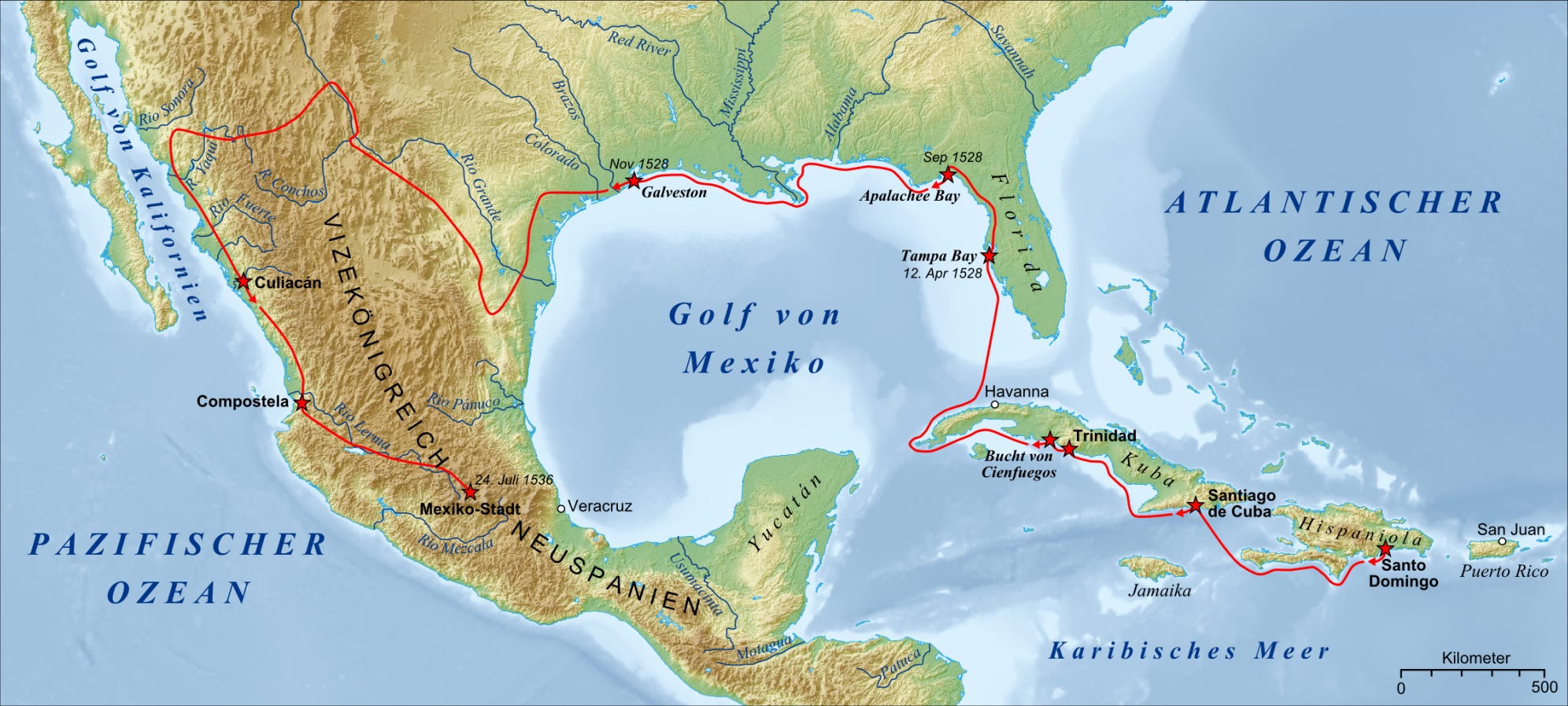
Santo Domingo: The First Desertion
We arrived at the Island of Santo Domingo in August and remained forty–five days to take on supplies. But the men heard stories—terrible stories of another expedition that had recently returned, in which four hundred and fifty of six hundred men had perished. The tales spread through our company like fever.
More than one hundred and forty men refused to continue. They slipped away to make new lives on that island, preferring uncertainty to the dangers ahead.
Six hundred became four hundred and sixty.
Cuba: The Hurricane
The Governor sent me ahead to the port of Trinidad with two vessels to collect supplies from a wealthy friend. I left the pilots with strict orders: if the south wind rose, they should run the vessels ashore to save the men and horses.
I was ashore when the storm came.
Never has such a fearful thing been witnessed. The rain began gently, then the sea grew rough, and then—God preserve us—the north wind came with such violence that all the houses and churches fell down. We had to go about, seven or eight men locking arms at a time, to keep from being carried away. All night we heard a great uproar: the sound of voices, the tinkling of bells, flutes and tambourines, sounds I cannot explain to this day.
When morning came, I went down to the harbor. The ships were gone.
We found the little boat from one vessel in the treetops, a quarter league from the water. We found two bodies so disfigured by the rocks that we could not recognize them. We found a cape and a tattered quilt. Nothing else.
Sixty men and twenty horses perished in that single night.
Four hundred and sixty became four hundred.
Florida: The Fatal Decision
We reached Florida on Holy Thursday, the 12th of April, 1528, casting anchor at a bay near what is now St. Petersburg. Of our eighty horses, only forty–two remained—the others had died from storms and the long time at sea. Those that survived were so thin and weak they could barely walk.
The Governor wished to march inland to find a province the Indians called Apalachen, where they said there was much gold. The pilots believed we could easily find a harbor along the coast. I argued against dividing our forces—I told the Governor that if we left the ships, we would never see them again, that we had no interpreter, no knowledge of the country, and not enough food for such a journey.
He accused me of cowardice and ordered me to stay with the ships.
I refused. I told him I would rather expose my life than, under such circumstances, my good name. So on the first of May, three hundred of us marched inland. Each man carried two pounds of biscuit and half a pound of bacon.
We never saw those ships again. We never saw the hundred men who sailed with them. Whether they perished at sea or lived, I do not know.
Four hundred became three hundred.
The March to Apalachen
We marched for fifteen days eating nothing but palmetto hearts, finding neither villages nor people. At a deep river with a swift current, Juan Velázquez of Cuéllar, impatient with the crossing, rode his horse into the water. The current swept him from the saddle. He grabbed the reins and was pulled under, drowning with his horse.
His death caused us much grief, for until then we had not lost a man.
The Indians harried us constantly – shooting arrows from behind trees, from fallen timber, from the depths of lagoons where we could not reach them. I saw an arrow pierce the base of a poplar tree for half a foot. I saw oak trunks shot clean through. These people were wonderfully built, tall and naked, and their bows could kill from two hundred paces with unerring aim.
When we finally reached Apalachen on the day after St. John’s Day [near present – day Tallahassee – the name would later be given to the great mountain range to the north], we found not gold but forty small huts, some corn, and a people who wanted us gone. They set fire to our lodges while we slept.
We learned that this was the largest village in all the region. Farther in, the Indians told us, there were fewer people, poorer, and nothing to eat.
We had marched three hundred leagues to find this.
The Building of the Barges
By August, we had reached the sea at a place we called the Bay of Horses [near present-day St. Marks, on Florida’s Gulf coast], but we were trapped. Over forty men had died from sickness and hunger. The Indians wounded us daily, picking us off when we went for water. We could not go forward and we could not go back.
Then one man came forward and said he could make wooden bellows from deer skin and forge tools from our stirrups, spurs, and crossbows. We agreed—though none of us knew how to build ships.
We slaughtered our remaining horses, one every three days, to feed the workers. We made ropes from palmetto fiber and the tails and manes of our horses. We made sails from our shirts. A Greek among us made pitch from pine trees. We flayed the legs of the horses and tanned the skin into water pouches.
By the 22nd of September, we had eaten all the horses but one. We had built five barges, each twenty–two cubits long. We had two hundred and forty–two men left.
Three hundred had become two hundred and forty–two.
We embarked with the barges riding so low that the sides rose barely half a foot above the water. We were so crowded we could not move. Not one of us knew anything of navigation.
Part Three: Lost at Sea
For thirty days we crept along the coast, entering inlets, always thirsting, our supplies dwindling. The leather pouches we had made from horse legs rotted and became useless. We went five days without water, and five men drank so much seawater that they died suddenly before our eyes.
Near a great bay, Indians appeared friendly at first. They fed us, took us to their village, and then at midnight fell upon us with stones and arrows. We fought through the night, attacked three times, and in the morning I destroyed thirty of their canoes so they could not pursue us.
The barges became separated in storms. We lost track of the Governor’s barge, and he of ours. When I came alongside him one day and asked what we should do, he said each man should do the best he could to save himself. He pulled ahead, and I never saw him again.
Later I learned what became of him: a north wind carried his barge out to sea in the night while he slept aboard with only a pilot and a sick page. They had neither water nor food. They were never seen again.
The barge of Captains Téllez and Peñalosa was lost in a storm. All hands perished.
The barge of the purser and the friars ran aground. Those men survived the wreck only to die slowly through the winter from cold and starvation. The last survivor, a man named Sotomayor, was eaten by his companions before he too died. Another survivor, Esquivel, cut him up and fed on his body until the first of March, when Indians found him and took him captive.
Two hundred and forty-two became eighty.
The Island of Ill–Fate
On the sixth of November, a wave hurled my barge onto the shore of an island [near present-day Galveston, directly south of Houston]. We came to ourselves lying in the surf, half-drowned, naked – for we had stripped to work the oars – and the cold was so severe that we looked like figures of death itself. Every bone could easily be counted through our skin.
Indians came. When they saw our misery – our nakedness, our wasted bodies – they sat down beside us and wept. For more than half an hour they wept so loudly it could be heard far away.
To see beings so untutored, whom we had thought savages, so deeply moved by pity for us – it increased my own grief and that of my companions for our misfortune.
They carried us to their village, built fires along the way so we would not die of cold, and that night celebrated our arrival with dancing. I expected we would be sacrificed. Instead, they fed us fish and roots.
But winter came, and with it starvation. The Indians themselves began to die from a sickness of the stomach – so many that half their number perished. They believed we had caused it and resolved to kill us. Only one Indian, the one who had kept me, spoke against it. He said if we had such power, we would not have let so many of our own people die. They listened to him, and we were spared.
But others were not so fortunate.
Five Christians on the coast – Sierra, Diego López, Corral, Palacios, and Gonzalo Ruiz – grew so desperate from hunger that they ate one another, until only one remained. When the Indians discovered this, they were horrified. They would have killed all of us had they seen it at the beginning.
Three more men – Diego Dorantes, Valdivieso, and Diego de Huelva – were killed by the Indians for going from one lodge to another without permission.
Esquivel and Mendez were killed because of an Indian woman’s dream.
Eighty became fifteen.
I gave that island the name Malhado – the Island of Ill-Fate [in the Galveston Bay area of the Texas coast].
Part Four: The Years of Bondage
I remained among those Indians for more than a year, and they used me hard. I was made to dig roots from underwater, among the canes, until my fingers were so tender that a straw would make them bleed. The reeds cut me constantly, and I had no clothing to protect myself.
Finally I escaped to a tribe on the mainland and became a trader. I carried shells and beads inland, and brought back hides and red ochre. This gave me freedom to travel, and more importantly, to search for my surviving companions.
For nearly six years I lived naked among those people, alone for much of the time, waiting for an opportunity to escape to the south. Every year I crossed to the island to persuade Lope de Oviedo, the only other Christian I knew of, to flee with me. Every year he put it off.
At last, in 1534, he agreed. I carried him across the inlets—for he could not swim—and together we sought out others. But when we heard that the Indians ahead had killed many of our companions and would kill us too, Oviedo lost his nerve and turned back.
I never saw him again.
But I pressed on and found them: Andrés Dorantes, Alonso del Castillo, and Estevanico the Moor. Of the six hundred men who had left Spain, we four alone remained.
Six hundred had become four.
Part Five: A Hard Land and Strange Ways
In the years I wandered among them, I came to know these people and their customs. What I witnessed still astonishes me.
The Hardness of Their Lives
These were the poorest people I have ever seen. They had nothing - no maize, no permanent homes, no possessions but their bows and the skins on their backs. They wandered constantly in search of food, and often there was none to find.
I often went three days without eating anything whatsoever, and they did the same. They were so accustomed to hunger that they scarcely noticed it. Their diet would horrify any Christian: they ate spiders and ant eggs, worms, lizards, salamanders, snakes—even the poisonous vipers whose bite is deadly. They ate tree bark and roots and deer dung. They swallowed earth and rotted wood. They pulverized the bones of fish and snakes and ate the powder. I believe that if there had been stones in that country, they would have eaten those too.
Their best time was when the tunas - the prickly pears - ripened. Then they had plenty to eat, and they would dance and celebrate day and night. But when we asked how long until the tunas came, they would say five or six months. So they cheered us with promises of future plenty while our bellies ached with present hunger.
The women worked without rest. Out of twenty–four hours, they got only six hours’ sleep. They spent most of the night stirring fires to dry the roots they ate. At daybreak they began digging, carrying firewood, hauling water. The men did nothing but hunt and fight.
The Plague of Mosquitoes
During the summer, there came mosquitoes of three kinds, all very bad and troublesome. We built great fires of damp and rotten wood that gave no flame but much smoke, hoping to drive them off. But the smoke was so thick we spent the whole night weeping from it, while the heat from the fires was so unbearable we would flee to the shore for relief. And when at last we might sleep, the Indians roused us with blows to go and kindle the fires again.
Some Indians used another remedy just as bad: they went about with firebrands, setting the plains and forests ablaze to drive away the mosquitoes. The whole country burned. This also forced the lizards and snakes from the ground so they could be caught and eaten.
The Mourning of Children
Of all the peoples in the world, these loved their children most. When a child died, the parents and relatives wept, and then the whole village, and the mourning lasted a full year. Every day before sunrise the parents began to weep, then the whole tribe joined them, and again at noon and at dawn. This they did for twelve months without ceasing.
But for the old who died, they showed no grief at all. They said the old had lived their time and were of no further use, and only took food from the children.
The Killing of Daughters
Among some tribes, I learned of a custom that chilled my blood. They killed their own daughters at birth, throwing them to be eaten by dogs.
When we asked why they did this terrible thing, they explained that all the neighboring peoples were their enemies, with whom they fought constant wars. If they raised their daughters and gave them in marriage, those daughters would bear children for their enemies, who would grow numerous and eventually enslave them. Better, they said, to kill the girls than to see them give birth to future foes.
We asked why they did not marry the girls among themselves. They said it was bad to marry their own kin. So instead, they purchased wives from their enemies. The price for a woman was one good bow and two arrows, or a fishing net a fathom square. And these marriages lasted only as long as both parties pleased - for a mere nothing, they would separate.
They also killed their own children on account of dreams. If a woman dreamed her child would do harm, they killed it without hesitation.
The Law of In-Laws
When a man took a wife, he was forbidden to enter the home of her parents ever again, and they were forbidden to enter his. If they happened to meet on a path, they would turn aside a crossbow’s shot, walking with bowed heads and eyes cast to the ground. They believed it evil even to look upon one another.
But the women were free to speak with their parents–in–law as they pleased. This custom prevailed for fifty leagues or more.
The Medicine Men
Their medicine men were held in high regard. When someone fell ill, the healer would make cuts where the pain was, suck on the skin around the incisions, and cauterize with fire. They believed this drew out the sickness. They also breathed upon the afflicted, thinking this chased the disease away.
When a medicine man died, they burned his body, and while the fire blazed, all the people danced and made a great festival. They ground his bones to powder, and a year later, at the anniversary of his death, they scarified themselves in mourning and gave the bone powder to his relatives to drink mixed with water.
The Sacred Drink
They made a drink from leaves of a certain tree, which they toasted in a vessel over fire, then filled with water and boiled three times. When they were ready to drink it, they would shout, “Who wants to drink?” At this cry, every woman froze wherever she stood. Even if she carried a heavy load, she dared not move a single step.
If any woman stirred while the water boiled, they beat her and threw out the drink. They believed that if a woman moved, an evil substance entered the liquid that would cause any man who drank it to die. The drink was yellow, and they consumed it for three days without eating, each person drinking an arroba and a half each day.
The Demon Called “Bad Thing”
The Indians told us of a being who had wandered among them fifteen or sixteen years before - a small man with a beard whose face they could never see clearly. They called him “Bad Thing.” Whenever he approached their dwellings, their hair stood on end and they trembled with fear.
A firebrand would appear in the doorway. Then the creature entered, seized whomever he chose, and with a sharp flint knife as broad as a hand, cut open their side, reached in, and pulled out their entrails. He would cut off a piece a palm’s length and throw it into the fire. Then he made three cuts on their arm, dislocated it, and soon after set it right again. He placed his hands on the wounds and they closed at once.
Many times, they said, he appeared among them while they danced - sometimes dressed as a woman, sometimes as a man. When he wished, he would seize their lodge, lift it into the air, and bring it crashing down. They offered him food, but he never ate. When they asked where he came from, he pointed to a crack in the earth and said his home was below.
We laughed at these stories. But they brought us many people who bore the scars of his slashes, exactly as they had described. We told them he must be a demon, and that if they believed in God our Lord and became Christians, they would have nothing to fear from him. They were greatly pleased to hear this, and lost much of their terror.
Part Six: Children of the Sun
We waited together for the season of the prickly pears, planning our escape. And it was among a people called the Avavares that everything changed.
On the night we arrived, Indians came to Castillo complaining of terrible headaches. They begged him for relief. He did not know what to do - none of us did - but he made the sign of the cross over them and recommended them to God. At that very moment, the Indians said all the pain was gone.
They went back to their lodges and returned with tunas and venison - meat we had not tasted in so long I had forgotten what it was. And as the news spread that same night, more sick people came, each bringing food, until we had more than we could store.
We gave thanks to God for His mercy.
The next day, they brought five paralyzed men, so ill they seemed near death. Castillo prayed over them. By morning, all five rose and walked away as if they had never suffered any ailment.
Then came the man I believed to be dead. I found him with his eyes rolled back, no pulse, cold to the touch. I removed the mat covering him and prayed to God as best I could. I made the sign of the cross and breathed upon him many times. That night, the Indians came running to say he had risen, walked, eaten, and spoken.
This caused such astonishment that all over the land nothing else was spoken of.
The Arrowhead in the Heart
At one village, they brought me a man who had been shot long ago with an arrow. The head was lodged near his heart, and he said it gave him constant pain. I felt his chest and found the arrowhead had pierced the cartilage.
With a knife, I cut open his breast until I reached the place. The arrow point had turned sideways and was very difficult to remove. I cut deeper, inserted the knife point, and at last pried it out. It was as long as my hand. With a bone from a deer, I made two stitches according to my knowledge of surgery.
The next day I cut the stitches. The man was healed. He said he felt no pain whatsoever. The wound left only a scar like a line in the palm of a hand.
The whole village came to see the arrowhead. They sent it far inland so that others might see what had been done among them.
The Growing Fame
From that time forward, they called us children of the sun and believed we had power over life and death. People came from villages we had never seen, having traveled for days just to be touched by us. We had no choice but to become healers - all four of us - for they withheld food unless we would bless the sick.
Our method was simple, for we had no medicine. We made the sign of the cross, breathed upon the afflicted, prayed the Pater Noster and Ave Maria, and commended them to God our Lord. And He, in His infinite mercy, granted them health.
As we traveled westward toward Mexico [crossing what is now Texas, then turning south through the states of Coahuila and Chihuahua into Sinaloa], our fame preceded us. Villages emptied as people came to meet us on the trail. They gave us everything they owned—not just food but deerskins, beads, copper rattles, emeralds shaped like arrowheads. Those who accompanied us would plunder those who received us, taking all their possessions. Yet no one complained. The plundered ones said they were happy just to see us, that they would recover their losses from others farther on, and so it proved.
Sometimes three or four thousand followed us at once. They built ovens to cook our food and would not eat until we had blessed every morsel. Women brought their newborns straight from birth to receive the sign of the cross. The press of bodies became so great we could barely breathe.
And still the sick came, night after night, so many we could not sleep, so many we could scarcely attend to them all.
Part Seven: The Bitter Reunion
In January of 1536, after nearly eight years in the wilderness, we began to see signs of Christians [in what is now the Mexican state of Sinaloa, on the Pacific coast]. The villages were empty. The fields lay fallow. The people hid in the mountains.
The Indians told us what had happened: men with beards had come from the south, men on horses with lances, and they had killed and enslaved everyone they found. The survivors had fled into the forest rather than face such cruelty again.
My heart filled with sorrow. The land was beautiful and fertile, full of water and streams, but abandoned. The people we met were thin and wretched, eating tree bark and roots, afraid to plant crops lest the Christians return.
When at last we found the Spanish soldiers, I told their captain, Diego de Alcaraz, that he should treat the Indians kindly. He asked us to bring people down from the mountains, promising they would not be harmed. We did as he asked, using what authority we had among the natives. Six hundred came to meet us, bringing all the corn they had hidden.
Then the Christians demanded we turn the Indians over to them as slaves.
We refused. We had many bitter quarrels over this. The Indians watched and listened, and afterward they spoke among themselves. They said the Christians lied - that we had come from where the sun rises, and the Christians from where it sets. They said we cured the sick, while the Christians killed those who were healthy. They said we went naked and barefoot, taking nothing and giving away all we received, while the Christians had no purpose but to steal.
We could not convince them we were the same people.
And in my heart, I wondered if they were right.
Epilogue
We reached Mexico City in July of 1536, nine years after we had left Spain with six hundred men and dreams of conquest. The Viceroy received us well and gave us clothing - though for many days I could bear none, having lived so long naked. We could not sleep except on the bare floor.
I returned to Spain the following year, and this testimony I have written for His Majesty, that he might know what befell us and what manner of people inhabit that vast land.
In all our travels - two thousand leagues on land and sea - we found neither gold nor silver nor precious stones. We found only people: some kind, some cruel, all of them struggling to survive in a hard country.
But we also found something else: the mercy of God our Lord, who preserved us through countless dangers, who gave us favor in the eyes of those we healed, and who brought four naked, starving men across a wilderness no Christian had ever seen.
We left Spain as conquistadors.
We returned as witnesses.
—Álvar Núñez Cabeza de Vaca
Jerez de la Frontera, 1542
Author’s Note
This narrative is adapted from the original testimony of Álvar Núñez Cabeza de Vaca, first published in 1542 as La Relación (The Account) and later republished as Naufragios (Shipwrecks). All major events, casualty figures, and details of Indian customs are drawn directly from his account. The narrative voice and structure have been adapted for modern readers while preserving the factual content of his remarkable testimony.
The English translation of his account is available here.
The Man Who Survived
Why did Cabeza de Vaca survive when nearly six hundred others perished? The answer lies partly in the man he was before he ever set foot on a ship bound for Florida.
Álvar Núñez Cabeza de Vaca was born around 1490 in Jerez de la Frontera, in southern Spain. Orphaned before his teenage years, he was raised by his aunt and uncle. His grandfather was Pedro de Vera, the conquistador who conquered the Canary Islands—a man remembered for his ruthlessness. Young Álvar grew up hearing stories of conquest and surrounded by indigenous Guanche slaves from those islands. His very surname came from an ancestor who helped win a crucial battle against the Moors by marking a secret mountain pass with a cow’s skull, allowing Christian forces to surprise and defeat their enemies.
He joined the Spanish army as a teenager and first saw combat in the Italian Wars. In 1512, at about twenty–two years of age, he fought at the Battle of Ravenna—one of the bloodiest engagements of the era. The battle lasted eight hours and left over ten thousand dead on the field, with seventeen thousand civilians massacred in the aftermath. Some accounts indicate that Cabeza de Vaca suffered severe wounds there. He went on to fight in the Revolt of the Comuneros, a Spanish civil war, and in the defense against the French invasion of Navarre in 1521. By the time he joined the Narváez expedition, he was a seasoned veteran with fifteen years of combat experience—a man who had already survived horrors that would have broken most others.
His appointment as royal treasurer was not merely administrative. It made him the King’s representative, responsible for protecting the Emperor’s interests, and placed him second in command of the entire expedition. He also had a relative on the powerful Council of the Indies. He was, in short, a man of proven loyalty, tested courage, and considerable political standing.
A Different Kind of Conquistador
Even through the self–serving lens of his own narrative, certain qualities distinguish Cabeza de Vaca from the typical conquistador of his era. He consistently warned against the decisions that doomed the expedition: he objected to splitting from the ships, objected to the inland march, objected to dividing their forces. When Narváez accused him of cowardice for these warnings, he chose to march into danger rather than have his honor questioned, writing: “I preferred risking my life to placing my honor in jeopardy.”
When the survivors were on the verge of mutiny and despair, it was Cabeza de Vaca who rallied them and organized the desperate effort to build boats from horsehide and palmetto fiber. When Narváez fell ill, Cabeza de Vaca became the de facto leader of the remaining men. And when Narváez finally abandoned his own people to save himself—sailing off alone into the Gulf and vanishing forever—Cabeza de Vaca stayed with those who depended on him.
Most remarkably, while other survivors clung to their Spanish identity and died, Cabeza de Vaca adapted. He went native in ways that would have horrified most conquistadors. He lived naked for years. He learned to dig roots from underwater until his fingers bled. He ate spiders and ant eggs and deer dung. He became a trader, traveling alone between hostile tribes, building relationships through commerce and trust rather than conquest. Where others saw only savages to be subdued, he learned to see human beings whose customs, however strange, had their own logic and meaning.
This willingness to adapt—to become something other than a conquistador in order to survive—may be what ultimately saved him. The hardship that destroyed others became, for him, a crucible of transformation.
The Legacy
Cabeza de Vaca’s account, La Relación, published in 1542, was the first written description of the interior of North America by a European. It remains the only firsthand record of many of the indigenous peoples he encountered—tribes whose cultures were soon destroyed by disease and colonization. For historians and anthropologists, his detailed observations of customs, languages, and ways of life are irreplaceable.
His testimony also sparked the next great wave of Spanish exploration. His reports of wealthy pueblos in the north led directly to the Coronado expedition of 1540, which searched in vain for the legendary Seven Cities of Cíbola. Estevanico, one of the four survivors, was sent ahead as a scout and was killed by the Zuni. Hernando de Soto tried to recruit Cabeza de Vaca as his second–in–command for his own expedition; Cabeza de Vaca refused, having learned his lesson about serving under other men’s commands, but he privately advised his relatives who joined De Soto to “sell their estates and go.”
Perhaps most remarkably, this grandson of a merciless conquistador emerged from his ordeal as an advocate for the humanity of indigenous peoples—a rare voice in an age of conquest and exploitation. When he encountered Spanish slave–catchers near the end of his journey, he argued bitterly against their treatment of the Indians who had helped him survive. The natives themselves observed the difference: “We cured the sick, while the Christians killed those who were healthy.”
Later appointed governor of Paraguay, Cabeza de Vaca led two hundred settlers on a 1,200–mile march from the coast of Brazil to Asunción. To inspire his followers, he took off his shoes and walked every step of the way barefoot, though horses were available. He had already proven he could walk across a continent without shoes. The hardship that had nearly killed him had become simply a way of being.
His governorship ended badly—political enemies had him arrested and sent back to Spain in chains, where he was convicted of corruption and briefly banished. He died in poverty around 1560, his later failures overshadowing his remarkable survival. But his account endures: the testimony of a man who left Spain as a conquistador and returned as something else entirely—a witness to a world that would soon vanish, and to his own transformation within it.
Sources
This narrative is adapted primarily from Cabeza de Vaca’s La Relación (1542), using the translation by Fanny Bandelier (here). Additional context is drawn from the Joint Report prepared by the four survivors in Mexico City in 1536, as transcribed by the historian Gonzalo Fernández de Oviedo. Modern scholarly works consulted include Rolena Adorno and Patrick Charles Pautz’s definitive three–volume study, Álvar Núñez Cabeza de Vaca: His Account, His Life, and the Expedition of Pánfilo de Narváez (University of Nebraska Press, 1999), and Andrés Reséndez’s A Land So Strange: The Epic Journey of Cabeza de Vaca (Perseus Books, 2007).
Lyrics
The Ballad of Cabeza de Vaca
[Verse 1] Six hundred men set sail from Spain, With dreams of gold and glory, But hurricanes and hostile lands, Would write a different story. They marched through swamps and cypress groves, Where arrows filled the air, And one by one the soldiers fell, To fever and despair.
[Chorus] Cabeza de Vaca, walker of the sun, Stripped of sword and armor when the conquering was done, From the ashes of an army, from the shipwreck and the grave, Rose a healer, rose a wonder, rose a man the Indians saved.
[Verse 2] They built their boats from horsehide sails, And manes twisted into rope, Set out across the endless Gulf, With nothing left but hope, The Governor was swept to sea, And vanished in the night, While eighty souls washed up on shore, More dead than half alive.
[Chorus] Cabeza de Vaca, walker of the sun, Stripped of sword and armor when the conquering was done, From the ashes of an army, from the shipwreck and the grave, Rose a healer, rose a wonder, rose a man the Indians saved.
[Verse 3] For six long years he walked alone, A trader and a slave, He dug for roots with bleeding hands, And slept inside a cave, He ate the spiders and the worms, The lizards and the snakes, And learned to live as Indians lived, For bare survival’s sake.
[Bridge] Then something changed beneath his hands, A power he couldn’t name, He prayed the cross, he breathed on them, And sick men rose again.
[Verse 4] They came by hundreds, came by thousands, Pressing all around, The paralyzed, the blind, the dying, Covering the ground, They would not eat until he blessed, Each morsel that they had, They called him child of the sun, And wept when he was sad.
[Verse 5] Three thousand souls would follow him, Across the desert sand, They gave him everything they owned, Just to touch his hand, The women brought their newborn babes, Still wet from the womb, And men who should have long been dead, Walked living from the tomb.
[Chorus] Cabeza de Vaca, walker of the sun, Stripped of sword and armor when the conquering was done, He left Spain as a soldier, came back something more - A witness to the wonders that he never asked for.
[Outro] Six hundred sailed, and four returned, Across nine years of pain, He wrote it down so we would know, They did not die in vain.
Adoran
I used the story of Cabeza de Vaca in the writing of my fantasy novel Adoran: The Hall of Prophecies. In the story, an Indian Chief, thankful for Cabeza healing his son, gives Cabeza his most precious possession - a box with another world inside it.

Here’s the excerpt from the story:
“Have you really been here for five hundred years?” I asked him.
“Has it been that long? Well, I suppose so, one tends to lose track of time here.”
“But I didn't think there were any white people in the Southwest that long ago.”
“Southwest? Do you mean northern Mexico?”
“Well yes, I suppose, but how did you get there? I've read of Francisco de Coronado. Were you part of his expedition?”
“Coronado? No, I don't know of him. As far as I know we were the first in that region of northern Mexico. But by that point, we were no longer part of any expedition.”
Elcørn saw the lack of comprehension on my face, so he continued.
“Look, it's a long story but originally, I was just a cabin boy on one of five ships that set sail with about 600 men on June 27th, 1527 from the port of San Lucar de Barrameda in Spain under the command of Governor Panifilo de Narvaez on an expedition to find cities of gold. We never did find any gold, but after we landed in the Cape of the Florida, we quickly lost most of our men and ships to storms.
“What happened after that could well fill an entire book. The survivors were captured by the local Indians and made their slaves, but eventually a handful of us escaped and made our way across the mainland hoping to reunite with Spanish settlements that we knew of on the coast of Mexico.
“This took a number of years so that by the time we made it to northern Mexico, I had just turned 18. At that point we met some Indians that said they came from villages high on some mesas to the north.”
“Yes, I've been there,” I interrupted. “They said they gave you the box as a gift.”
“Ah yes. The Indian chief assured me that he would carry out my requests. I can see that he kept his word to me.”
“But why should the Indian chief give you such a valuable gift as this box? They said something about his son being healed, but that didn't seem very likely to me.”
“Oh, my dear princess!” Elcørn said, smiling once again. “You have so much to learn. Indians far and wide gave us many gifts back in those days!”
“But why?”
“Because we healed their sick, that's why! We were as surprised as they were that they were healed. We even refused at first thinking we could not do it. But it was either that or starve to death, so we did the only thing we knew how -- we prayed.”
“Starve to death?”
“Yes, when we were slaves, we had to work with an Indian medicine man. He demanded we use our 'medicine' on sick Indians to heal them. Since we only knew a little real medicine -- which didn't help much -- we kept telling him we couldn't do it. But he took our food away telling us we couldn't eat again until we healed the sick Indians.”
“That's incredible!”
“Not nearly as incredible as seeing people get healed of all kinds of sicknesses. We even had one Indian that I thought for sure was dead, but we prayed for him and the next day he was up and about. Indians started coming from everywhere as word spread about the healings and it got very tedious praying over multitudes of Indians and all their things that they wanted us to bless. They followed us by the hundreds and sometimes by the thousands on our trek across the mainland, constantly bringing us gifts.
“In the case of the chief's son, he was at the point of death when the chief brought him to us. So, when he was healed the chief was so thankful that he gave us the most valuable gift he possessed -- this box.
“And when I heard of this box, I wanted to go in immediately, but the chief warned us not to. But since we had originally been sent to find cities of gold, we knew we had to search out this new land. Our leader, Alvar Nuñez Cabeza De Vaca*, decided it would be best if I went in first to check it out as I was the strongest. And when the chief saw that I was going to go in, he insisted that he go in as well.
[* The true and amazing story of Cabeza De Vaca (minus the box) can be found online.]
“And well, that's how I ended up here. The chief was extremely skilled as a warrior and was able to fight his way out, but I have been trapped ever since.”


