

I asked Claude to write up Daniel chapter 5 as a historically based story, drawing from the account of the historian Herodotus as well as archaeological evidence. The thing is, this isn’t just a historical story. It’s a story God made part of scripture because He wanted us to learn from it. We may think we’d never behave as king Belshazzar did on that fateful night - and yet too often we do - because we’ve forgotten something very important.
The Night the Walls Did Not Matter
I. The King on the Parapet
Belshazzar stood on the high rampart and looked out over the plain.
Below him, the campfires of the Medo-Persian army stretched in a wide arc to the horizon — small as candleflames from this height, harmless as fireflies. They had been burning for months. Let them burn for months more. Let them burn for years. The fool king of Persia could sit out there in his tent and grow old and gray and watch his beard turn white in the wind, and Babylon would not yield a single brick.
Belshazzar set his hand against the parapet and felt, beneath his palm, the great work of his grandfather Nebuchadnezzar. The wall was as wide as a country road. Two chariots could race side by side along its top and never touch each other. He had seen it done. He had ordered it done at festivals, the horses thundering above the city while the people cheered from the streets below. The wall itself rose so high that the ravens, when they flew up from the river, were still beneath him when they passed.
Three walls, in truth. An outer rampart of mud brick, buttressed with towers. Then a moat — deep, broad, fed from the Euphrates and never dry. Then the great inner wall of baked brick, set with bitumen so that water could not eat it and fire could not burn it. Then a second inner wall behind that. The Greeks who came as traders said there was no fortress like it in the world, and the Greeks, as everyone knew, were difficult to impress.
And through the heart of it all flowed the Euphrates itself — wide, slow, swollen with the spring rains from the northern mountains. The river entered the city beneath enormous bronze water-gates set into the wall, and left it the same way at the southern end. Quay walls ran along both banks inside the city, faced in baked brick. There was no gap. There was no breach. A man could not swim under the gates without drowning in the iron grates, and an army could not pass the gates at all.
Belshazzar smiled. The granaries were full. The cisterns were full. The wine cellars, by the count of his steward that very morning, held enough for ten years of feasting. The besiegers out there on the plain were the besieged. They simply did not yet know it.
He turned from the parapet and descended toward the palace. His mind, on the way down, was already moving toward a thought that pleased him very much.
Such might as I possess deserves a feast.
A thousand lords were already in the great hall by the time he entered, and a thousand cups were already lifted to him.
II. The Vessels
“My lords!” Belshazzar called out, and the hall fell quiet.
“My lords — out there on the plain, an army squats in the dust and dreams of my walls. They cannot climb them. They cannot dig beneath them. They cannot break them. They will sit there until the crows take their eyes, and Babylon will not so much as notice. Tell me — does this not call for a celebration worthy of the king who reigns within these walls?”
The hall roared. Cups went up. Wine sloshed onto the polished stone.
“Wine!” he shouted. “More wine! Better wine!”
But even as the stewards ran to obey, something in him pressed for more. The ordinary cups of gold and silver, the household vessels of the king of kings — they were not enough tonight. They felt small in his hand. He wanted a gesture. He wanted a sign. He wanted every man in this hall, and every god in every heaven, to know what manner of king he was.
The thought came to him then, the thought he should not have entertained. It came with a small inner shadow, a faint pulling-back of the soul, the way a child draws back from a fire he has been told not to touch. He remembered his grandfather. He remembered the stories — the great Nebuchadnezzar, mightier than any king before him, driven out into the fields to eat grass like an ox until he learned that the God of the Hebrews ruled over the kingdoms of men. He remembered that his grandfather had brought back, from the sack of Jerusalem, a treasure of golden vessels — vessels from the temple of that God — and that even Nebuchadnezzar, in the end, had not dared to drink from them. They sat in the treasury. Sealed. Untouched. Set apart.
Set apart. The phrase brushed past him like a hand on his shoulder.
He shrugged it off.
“Bring me,” he said, and his voice carried the length of the hall, “the cups of the Hebrew God. Bring me the vessels my grandfather brought from Jerusalem. Tonight my princes and my wives and my concubines shall drink from them, and we shall toast the gods of Babylon — the gods of gold, the gods of silver, the gods of bronze and iron and wood and stone — with the cups that the Hebrews said belonged only to their God. Let it be seen tonight, in this hall, whose god is greater.”
The stewards hesitated. He saw them hesitate. He stared at them until they ran.
When the vessels came, they were beautiful — more beautiful than he had expected. Hammered gold worked with a craftsmanship that even Babylon could not match. Bowls. Lampstands. Pitchers shaped like pomegranates. Long-necked ewers chased with twining vines. They had been made, his grandfather’s records said, by a man named Bezalel, in a desert, more than seven centuries ago, for a tent.
Belshazzar laughed at the thought of a tent.
He took a great golden bowl, filled it with wine, and lifted it high.
“To the gods of gold!” he cried.
A thousand voices answered him. A thousand sacred vessels rose into the lamplight. A thousand mouths drank the wine of Babylon from the cups of the Living God.
It is a strange thing, what pride will let a man do — even when, somewhere in the back of his mind, a small voice is saying: you know better, you know better, you know better.
III. The Hand
It began as a sound.
Not a thunderclap. Not a trumpet. A sound much worse than either of those, because it was a sound that did not belong in a banquet hall — a sound that did not belong indoors at all. It was the sound of a mason at work. A slow, dry, scraping sound. A chisel biting stone. The grit of plaster grinding away.
The hall went still by degrees. A man here, a man there, set down his cup. A woman turned her head. Someone laughed nervously and was hushed. The musicians faltered. The flutes died. And in the silence the scraping went on — louder now, deliberate, unhurried, as though whoever was doing the work cared nothing at all for what the king and his thousand lords might think.
Belshazzar turned toward the sound.
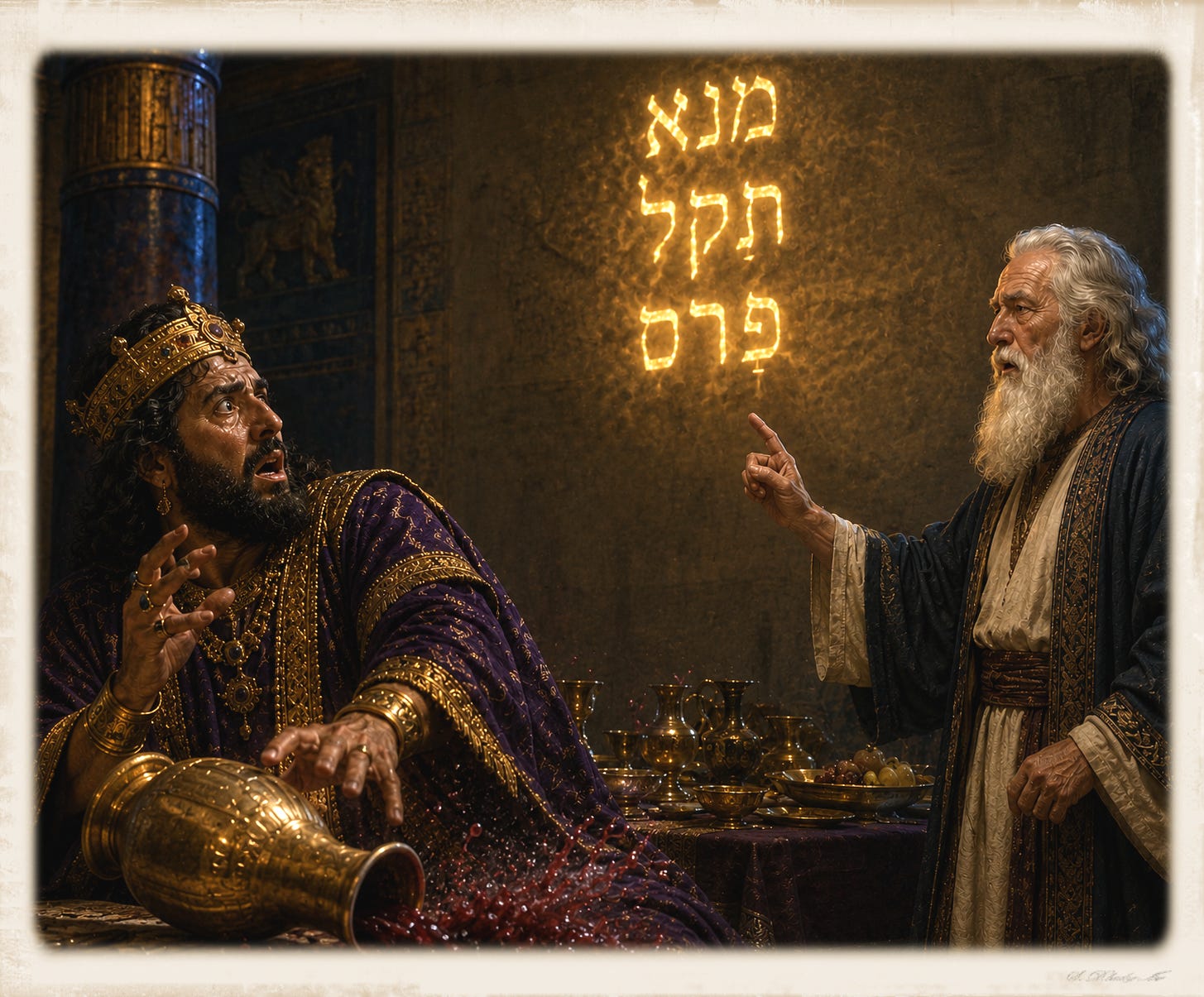
Against the white plaster of the wall, across from the great lampstand, where the light fell brightest, a hand was writing.
A hand. No arm. No body. No man. Only the fingers of a human hand, moving slowly across the wall, and where they passed, the plaster opened like a wound and letters appeared — gouged into the stone beneath. Hebrew letters. Or letters like Hebrew. Or something older than Hebrew. They burned into the wall one stroke at a time, and the dust of the plaster drifted down and settled on the floor in a little pale line.
Belshazzar’s golden bowl slipped from his hand. It struck the table, rolled, and fell. Wine ran across the cloth and dripped onto the stones — red as blood in the lamplight.
The scripture says the king’s countenance was changed. That is one way to put it. Another way: the color of life left his face like water poured out of a jar. His knees would no longer hold him. His hands shook so badly that he had to grip the arms of his chair to keep from falling. The book says his joints loosened — and that is also true — but more than his joints. The thing inside him that had carried him up the parapet that afternoon, the thing that had laughed at the campfires on the plain, the thing that had reached for the holy vessels and not been able to stop itself — that thing had gone out of him.
The hand finished its work. It withdrew. It was gone.
Four words stood on the wall.
“Bring them in,” Belshazzar whispered. He could not make his voice loud. “Bring in the wise men. Bring in all of them. Every one.”
They came. They had been waiting in the antechambers as they always did, and they came in their robes and their conical hats and their long beards, and they bowed before the king. They were the most learned men in the world. The Chaldeans — the priestly caste who had spent their lives in the towers of the ziggurats reading the wheel of the stars. The ashipu, the incantation-priests, who knew the names of every spirit between heaven and the underworld. The hartumim, the engravers and dream-readers, who could trace the meaning of a smudged liver or a falling bird. The mekashshephim, the sorcerers, with their roots and oils and whispered binding-words. The gazerin, the deciders, who read omens. The astrologers, the diviners, the soothsayers. Every form of knowledge Babylon had ever gathered to itself stood in that room.
Belshazzar pointed at the wall.
“Read it,” his steeled voice rose. “Whoever reads this writing and tells me its meaning shall be clothed in royal purple. A chain of gold shall be placed about his neck. And… and he shall rule as the third man in this kingdom, after only me and my father Nabonidus. Read it. Read it now.”
They went up to the wall. One by one. Then in groups. They stared at the letters. They pointed. They argued. They consulted scrolls brought from their prestigious libraries. They knelt and they tilted their heads and they whispered to one another behind their hands.
They could not read it. Not one of them.
They could not even agree on what language it was.
The king sat in his chair, and his lords stood in their places, and no one spoke. The hand was gone, but the writing remained, and no one in the wisest court earth had known could say what it meant.
IV. The Queen Mother
She had not been at the feast.
She had heard the noise of it from her chambers — heard the music, heard the shouting, heard, at one point, a cry go up that made her set down her work and ask the servant girl what was happening. They are drinking from the Hebrew vessels, my lady. The old woman had closed her eyes for a long time after that.
Now she came into the hall. She was the queen mother — by some accounts the widow of Nebuchadnezzar himself, by others his daughter — but in either case she had lived long, and she remembered what Belshazzar had forgotten, and she was not afraid of him.
“O king, live forever,” she said, though they both knew what kind of words those were tonight. “Do not let your thoughts trouble you, and do not let your face be changed. There is a man in your kingdom in whom is the spirit of the holy God. In the days of your grandfather, light and understanding and wisdom, like the wisdom of the gods, were found in him. Your grandfather — your grandfather the king — made him chief of the magicians, the enchanters, the Chaldeans, and the astrologers. Because an excellent spirit was in him, and knowledge, and understanding to interpret dreams, and to explain riddles, and to solve problems. His name is Daniel. Nebuchadnezzar gave him the name Belteshazzar.”
Belshazzar flinched at the name. Belteshazzar. It was very like his own — may Bel protect the king — and yet it was not his own, and the man who bore it had been honored before he was ever born.
“Let Daniel be called,” the queen mother said, “and he will show the interpretation.”
She said it gently. But Belshazzar understood what was beneath it. His grandfather, the greatest king Babylon had ever known, had set this Hebrew exile over the wise men of the realm. And Belshazzar, in his time, had pushed Daniel back into the shadows. He had not wanted, beside his throne, a man who answered to a higher one. He had not wanted, at his elbow, a memory of what had happened to his grandfather in the field of grass.
He had pushed Daniel away. And here was the queen mother, looking at him with the eyes of a woman who had seen better kings, telling him without quite telling him: this one, not you, was the wise choice. This one, not you, should be sitting where you sit.
“Call him,” Belshazzar said.
V. The Engineer at the River
While they searched the city for Daniel, twelve miles upstream, in the marshes outside the great basin that the old queen Nitocris had built generations ago, a man named Gobryas knelt in the mud and watched the water.
He was not a soldier, though he served a king who was. He was an engineer. He had been a Babylonian once — had served Nabonidus, in fact, as governor of the province of Gutium — and had gone over to Cyrus the Persian some months back, for reasons that were partly principled and partly practical and that he no longer cared to sort out. Cyrus, his new king, had asked him a question the day he came over: You know this country. You know this river. Tell me how to take Babylon.
And Gobryas had told him.
It was not a new idea. That was the strange and beautiful thing about it. The Babylonians themselves had given him the idea. Long ago, when their queen had wanted to lay deep foundations for the bridges and quays inside the city, she had built — to the west — an enormous artificial basin, a depression dug into the plain, miles across. She had cut canals from the river to the basin. She had opened the gates. The river had poured itself sideways into the basin while her engineers worked dry on the riverbed. When they were finished, she had closed the canals, and the Euphrates had returned to its bed, and the basin had been left as a marshy lake on the western horizon, half-forgotten.
Half-forgotten. But not by Gobryas. He had walked it as a boy. He had ridden along its banks as a young surveyor in the king’s service. He knew exactly how deep it was. He knew exactly how thirsty it was. He knew exactly how much water it could swallow if you gave it the chance.
And he knew what no Babylonian general had ever bothered to consider — because no general thinks about water, and no king thinks about engineers — which was that the river entered the city beneath the wall. The wall could not be climbed. The wall could not be undermined. But the river beneath the wall was only a river. And a river is only water. And water, given somewhere else to go, will go.
For weeks he had had Cyrus’s men digging. Not at the walls — never at the walls. Far upstream, where the Babylonians could not see. New channels. Wider channels. Old canals reopened and cleaned out and widened, all of them angling away to the west, all of them pointing at that great forgotten basin. The Babylonians, if they noticed the work at all, would have thought it was a siege camp shifting position. They would not have understood. Engineering is invisible to people who think only about walls.
Tonight was the night.
He had chosen it because his informants in the city — and a man who has changed sides keeps friends on both, the way a wet cloak collects burrs — had told him there was to be a great feast. Wine. Music. The whole court drunk. The watchmen on the walls drunk too, most of them, or wishing they were. A festival night. The night when the city would be looking inward at itself, dancing, while the river outside the wall went about its quiet business.
He gave the order.
The sluices opened. He felt it before he saw it — a deep low shifting beneath his feet, a change in the sound of the world. The Euphrates, which had run in its bed since the day God had set the rivers in their courses, began to lean. Slowly at first. Then more. The water on the surface kept moving south, toward the city, toward the great bronze gates — but underneath, the body of the river was already turning. Pulling. Bending west. The new channels drank it down. The old basin opened its mouth and drank it down. The river, which had been a thing, became two things, and then it became one thing again, but the one thing was no longer going where it had been going.
Gobryas walked downstream along the bank, his torch held high, watching the water-line on the reeds. It dropped a hand’s breadth in the first half hour. Then a forearm. Then to his knee. Then to his ankle. The river was not gone. The river would never be gone. But the river was now a stream, and a stream is a thing an army can walk through.
He turned and signaled to the captain waiting behind him. Far down the plain, at the place where the river entered the city, ten thousand Persian soldiers stepped down from the bank into the slack water and began to wade, in silence, toward the bronze gates of the wall — gates that were not gates, now, but only the empty arches under which a river had once flowed. There was nothing to stop them. There was no one even watching. The walls were as mighty as they had ever been. The walls did not matter anymore. The walls had been made irrelevant by a man with a shovel and the memory of an old queen’s basin in a marsh.
Gobryas exhaled and looked back at the city.
He could see, from this distance, the light of the palace burning above the rooftops — one steady glow in the dark, where a feast was going on. He wondered, with a kind of distant pity, whether the king of Babylon had any idea that the night had already turned against him.
He had no way of knowing — and would not learn until later, when men told the story — that the night had turned against the king of Babylon some hours earlier than that. In a banquet hall. In a single moment. When the king of Babylon had reached for a cup that did not belong to him.
VI. Daniel
They brought the old man in.
He was very old now. He had been a boy when Nebuchadnezzar had carried him out of Jerusalem in chains, and three kings had risen and fallen since then, and his hair was white, and his hands trembled with the small palsy of age, but his eyes were clear and they were not afraid.
There is something that ought to be said about him before he speaks, because it bears on everything that follows.
Daniel, too, had been set apart.
Not in the way the vessels had been set apart — he was a man, not a cup — but in the same kind of way. Long before he had ever stood in a king’s court, before he had ever been called Belteshazzar by the man who had carried him into exile, the God of the Hebrews had chosen him for a purpose, and the purpose was this: he would stand before kings, and he would speak, and what he spoke would not be his own.
It was a thing he had understood from the beginning. As a boy, when the chief of the eunuchs had tried to feed him from the king’s table, Daniel had refused — not because the food was bad, but because Daniel was not his own to be fed by another man’s table. As a young man, when Nebuchadnezzar had demanded a dream-interpretation on pain of death, Daniel had said plainly: No wise man, no enchanter, no magician, no astrologer can show this thing to the king. But there is a God in heaven who reveals mysteries. He had said it again to Nebuchadnezzar in the matter of the great tree. He had said it whether the news was good or bad. He had never, in seventy years in the courts of Babylon, claimed a single insight as his own. He was a vessel. The light came through him. The understanding came through him. The wisdom came through him. The credit, he had always insisted, with the persistence of a man who knew exactly what would happen to him if he forgot it, belonged to the One who had set him apart.
And because he had been faithful in that — because he had never once tried to use the holy gift for his own glory — he had outlasted kings. Nebuchadnezzar had risen and fallen and risen again, and Daniel had been there. Evil-Merodach had taken the throne and died, and Daniel had been there. Neriglissar had reigned and was gone. Labashi-Marduk had reigned a few months and was gone. Nabonidus had taken the crown and wandered off to the desert to dig up old inscriptions, and Daniel had been there. Belshazzar had risen, and pushed Daniel aside out of jealousy or out of fear or out of the wine-soaked confidence that he did not need an old man’s God, and still Daniel had been there — in some quiet quarter of the palace, in some forgotten chamber of the wise men’s quarter, white-haired now, waiting, because the One who had set him apart had not yet released him.
And tonight, at last, he had been called.
He stood before Belshazzar and he looked at him for a long moment without saying anything. Then he looked at the wall, where the four words burned, and his face did not change, because he had read them already from across the room.
“Are you Daniel,” Belshazzar said, “of the exiles of Judah, whom my grandfather brought out of Jerusalem? I have heard that the spirit of the gods is in you, and that light and understanding and excellent wisdom are found in you. The wise men have been brought in before me to read this writing and to make known to me its interpretation, but they could not. I have heard of you, that you can give interpretations and solve problems. Now — if you can read the writing and make known to me its interpretation, you shall be clothed with purple, and have a chain of gold around your neck, and you shall be the third ruler in the kingdom.”
Daniel waited until the king had finished. Then he spoke, and his voice was steady, and old, and very tired.
“Let your gifts be for yourself,” he said. “Give your rewards to another. I did not come to be paid, and I do not speak for myself. Nevertheless, I will read the writing to the king and make known to him the interpretation.
“O king — the Most High God gave Nebuchadnezzar your grandfather kingship and greatness and glory and majesty. And because of the greatness that He gave him, all peoples, nations, and languages trembled and feared before him. Whom he would, he killed; whom he would, he kept alive; whom he would, he raised up; and whom he would, he humbled. But when his heart was lifted up, and his spirit was hardened in pride, he was deposed from his kingly throne, and his glory was taken from him. He was driven from among men. His mind was made like that of a beast. He ate grass like an ox. His body was wet with the dew of heaven, until he knew that the Most High God rules the kingdom of men, and sets over it whom He will.
“And you, his grandson — Belshazzar — you knew all this. You have not humbled your heart, though you knew all this. You have lifted yourself up against the Lord of heaven. The vessels of His house have been brought before you, and you and your lords, your wives and your concubines, have drunk wine from them. You have praised the gods of silver and gold, of bronze, iron, wood, and stone, which do not see or hear or know. But the God in whose hand is your breath, and whose are all your ways — Him you have not honored.
“And so the hand was sent from His presence. And this writing was inscribed.”
Daniel turned to the wall.
“This is the writing. MENE, MENE, TEKEL, UPHARSIN.
“And this is the interpretation.
“MENE — God has numbered the days of your kingdom and brought it to an end.
“TEKEL — you have been weighed in the balances and found wanting.
“UPHARSIN — your kingdom is divided and given to the Medes and Persians.”
He stopped.
The hall was so quiet that Belshazzar could hear his own breath catch.
He did not cry out. He did not order Daniel killed. He did not even argue. There was, in him, the strange clear calm of a man who has finally heard, said aloud and from outside himself, what some inner voice has been whispering to him for hours. He nodded, slowly, almost as a student nods when a difficult lesson has at last been made plain.
“Robe him in purple,” he said quietly. “Put the gold chain on him. Proclaim him third in the kingdom.”
They did it. They had to. Daniel did not refuse a second time. He let them put the purple on his shoulders and the chain on his neck — he, who had stood in courts longer than most of them had been alive — and he stood there, an old man dressed up like a prince, in a hall that was already, though no one in it yet knew, no longer Belshazzar’s hall.
Because at that very moment, twelve miles to the west, the water was still falling. At that very moment, in the dry bed of the Euphrates, the first Persian soldiers were passing under the bronze gates of the wall. At that very moment, in a hundred quiet streets along the river, men in foreign armor were climbing up out of the mud onto the quays and discovering, to their astonishment, that no one had come to stop them. The walls towered above them, magnificent in the moonlight, and useless.
The book of Daniel ends the chapter in a single sentence.
That very night, Belshazzar the Chaldean king was killed.
VII. The Thing That Was Set Apart
There is a temptation, when one reads this story, to think the moral is about pride. And it is. But pride alone is too small a word.
Belshazzar’s sin was not, in the end, that he thought too highly of himself. It was that he took a thing that was set apart — a thing that did not belong to him — and he treated it as though it did.
The vessels in the treasury were not exceptional because they were gold. Babylon had gold. Babylon had warehouses of gold. The vessels were exceptional because, long before they had ever come to Babylon, they had been declared by the only voice in the universe that has the right to declare such things to belong to a single purpose, and to no other. They had been sanctified. Set apart. Holy. That word, in the old languages, does not mean glowing. It does not mean magical. It means belonging to. It means this is mine and not yours. It means do not touch.
And Belshazzar knew it. That is the worst of it. He was not ignorant. He had heard the stories. He had stood at the cabinet in the treasury and read the inscriptions. He had felt, in the moment of reaching for the cup, the small inward pulling-back of the conscience that the Most High God, in His great mercy, places in every human soul as a last warning. He had felt it. And he had drowned it in wine and in the cheering of a thousand drunk princes and in his own opinion of himself.
The walls did not save him. The walls were the greatest in the world, and they did not save him. The army did not save him. The army was massive and it did not save him. The wise men of the court — every magician, every astrologer, every Chaldean priest, every reader of livers and casters of lots — did not save him. The whole apparatus of Babylon, which had stood for centuries and would have stood for centuries more, was nothing in the hand of God on the night that Belshazzar reached for a cup that had been set apart.
And here, at the end, the parallel is too plain to be missed.
Two men stood in that hall. Two men with almost the same name. Belshazzar — may Bel protect the king. Belteshazzar — the name Nebuchadnezzar had given to a Hebrew exile in honor of a Babylonian god he himself did not really understand. One letter, one syllable, between them. They had lived the same decades. They had walked the same palace corridors. They had been shaped, both of them, by the same long memory of Nebuchadnezzar’s rise and fall.
And yet they could not have been more opposite.
Belshazzar took what had been set apart and used it for himself. Belteshazzar was himself set apart, and refused to use it for himself. Belshazzar reached for the holy vessels and drank from them to his own glory. Belteshazzar refused the purple and the gold chain even when they were lawfully offered, because the gift in him was not his to monetize. Belshazzar made himself the center of every sentence he spoke. Belteshazzar made God the center of every sentence he spoke, and in seventy years of standing before kings, never once claimed an interpretation as his own. Belshazzar lifted up the things of God to magnify himself. Belteshazzar lifted up himself only insofar as it magnified God.
And so consider what each man’s life amounted to, when the lamp burned low.
The one named may Bel protect the king — the king himself, born in the palace, raised in the purple, heir to the greatest city in the world — was dead before sunrise. His kingdom passed to other hands within the hour. His name survives in history only because it appears in this story, and in a handful of cuneiform tablets that no one read for two thousand years.
The one named may Bel protect his life — an exile, a foreigner, a man with no army and no city and no claim to anything — outlived him, outlived the empire that had taken him, served the new king who came in through the riverbed, and is still being read about, by you, tonight. His words shaped the prophets who came after him. His visions shaped the expectation of the Messiah. His example shaped the conscience of every man and woman who has ever held a position of influence and wondered whether to use it for themselves. The wise men from the East who came to a stable in Bethlehem six centuries later — magi, they were called, the very class Daniel had once been chief of — were almost certainly the inheritors of his school, and they came because something he had said, long ago, in a tower in Babylon, had told them when and where to look.
This is what it costs to be set apart, and this is what it is worth. The two men in that hall both ended up in the histories. But one of them ended up there as a cautionary tale, and the other ended up there as a witness.
There is, in this, a warning that does not stay neatly inside the story. When God says this belongs to Me, He is not making a suggestion. He is not opening a negotiation. He is telling you something about the structure of the universe. There are things — vessels, days, persons, promises, places, words, marriages, bodies — that have been set apart, and the man who takes them up and uses them for his own glory will find, sooner or later and usually sooner, that the walls he has built around his life are not as thick as he thought they were.
The river will turn. The river always turns. And the gates that were never meant to be passed will be passed, and the hand that nobody invited will write on the wall, and the only question that will matter, when it comes, is whether one has been listening, all along, to the small voice that was always saying:
You know better. You know better. You know better.
Epilogue: The Vessels in the Great House
Six centuries later, an old man sat in a Roman prison and wrote a letter to a young pastor named Timothy.
He had been arrested for the last time. He knew it. The headsman was coming, and he was making his peace with that, and the things he wanted to say to his young friend before the end he was saying carefully, the way a dying father speaks to a son. He spoke of soldiers and athletes and farmers. He spoke of suffering, and faithfulness, and the word of truth.
And then he reached, deliberately, for an image that any Jew reading his letter would have recognized at once.
In a great house, the old man wrote, there are not only vessels of gold and silver, but also of wood and clay, some for honorable use and some for dishonorable. Therefore, if anyone cleanses himself from what is dishonorable, he will be a vessel for honorable use, set apart as holy, useful to the master of the house, ready for every good work.
The old man’s name was Paul. He had been, in his younger days, a Pharisee — trained in the same Hebrew scriptures that Daniel had helped to shape, schooled in the same temple traditions that Belshazzar had once profaned. He knew exactly what he was doing when he reached for the vessel image. He was telling Timothy: you remember what the holy vessels were. You remember whose they were. You remember what happened to the king who took them up and used them wrongly. And he was telling him something more — something almost too large to write down in a single sentence, though Paul was the kind of man who tried anyway:
You are one of them now.
That is what the New Testament does with the vessels of the temple. It takes the image and it places it on you.
You — the reader of this sentence, the one holding this page, the one breathing in and out as your eyes move across these words — you are a vessel. You were made by hand, by a Craftsman who knew exactly what He was making and exactly what He was making it for. You were not made for common use. You were not made to be filled with the wine of Babylon and lifted up in toasts to the gods of gold and silver and bronze. You were made — the word is sanctified, and it does not mean what most people think it means — set apart. For Him. For His purposes. For His house. For the work of His hands.
Most Christians, somewhere along the way, forget this. They think sanctification means getting cleaner. It does mean that, but it means that only because the deeper thing is true first. The deeper thing is that you have been claimed. You have been picked up off the common shelf and moved. There is now a small inscription, invisible to the eye but visible to heaven, that says — in the same handwriting that wrote on the wall of Belshazzar’s palace — this one is Mine.
And here is the hard thing. The thing that ought to make every honest reader stop for a moment and put the page down.
A vessel can be profaned.
That is the whole point of the story you have just read. The vessels Bezalel made in the wilderness did not stop being holy when Nebuchadnezzar carried them out of Jerusalem. They did not stop being holy when they sat in a Babylonian treasury for seventy years. They did not stop being holy when a drunk king finally pulled them down and filled them with wine. They remained what they had always been — set apart, sanctified, the property of the living God — and that is precisely why the hand wrote on the wall. The vessels were not desecrated because they had stopped being holy. They were desecrated because they had not. The holier the vessel, the more terrible the profanation. The more set apart a thing is, the more serious God is when it is used for what it was never meant to be used for.
This is not a comforting thought. It is not meant to be.
A man can be a vessel of gold and live as a wooden bowl. A woman can be a vessel of silver and let herself be filled, day after day, with the cheap wine of whatever the world is selling that season — the gods of money, the gods of comfort, the gods of approval, the gods of self. The vessel does not stop being silver. The vessel goes on being silver, in the secret reckoning of heaven, the whole time it is being used as something less. And the Master of the house notices.
Most forget how significant it is to be called and set apart to God. Most forget that the word Christian once meant something almost dangerous — that the early believers understood themselves to be, in their very bodies, the temple of the Holy Spirit, the new vessels of a new sanctuary, the gold and silver of a kingdom that did not have walls because it did not need them. Most forget to live as Daniel did — quietly, faithfully, refusing the purple and the gold chain, never claiming the gift as their own, never using the holy thing for personal advantage, never confusing the vessel with the One whose vessel it is.
Most forget. And the story of Belshazzar is in the canon of Scripture precisely so that we will not.
The point of Daniel 5 is not to entertain us with a ghost story about a floating hand and a dead king. The point of Daniel 5 is to tell us, in language we cannot easily forget, that God is terribly serious about holy vessels. He was serious about them when they were made of hammered gold and sat in a tent in the desert. He was serious about them when they were carried into exile and kept in a treasury for seven decades. He was serious about them on the night a drunk king reached for them. He has not become less serious about them since.
He is just as serious about you.
You were not made for common use. You were not made for the wine of Babylon. You were made — at infinite cost, by a hand that knew you before the foundation of the world — for honorable use, set apart as holy, useful to the Master of the house, ready for every good work.
Daniel knew it. He lived seventy years in a foreign court and never forgot it. He stood before kings and never spoke for himself. He refused the gold chain even when the king of the world tried to put it on his neck, because the gift in him was not his to sell. He was a vessel, and he knew Whose.
Belshazzar knew it too. He simply did not care.
And one of them died that night, and one of them did not, and the difference between them is the difference that this story, in the end, is asking each of us to consider.
What kind of vessel are you?
When God weighs you, does He find a vessel of honor that He can freely use as He desires - as He used Daniel? Or does He find a vessel that has been tragically dishonored - even though all along - you knew better.
Lyrics
[Verse 1]
At the banquet hall
gold cups in the smoke
He raised them high
and told his own joke
On sacred wood
on stolen pride
The old floor trembled
then the words came alive
MENE, MENE
written in the air
The lamp burned low
like a warning prayer
[Pre-Chorus]
Do not be used
for dishonor
Brother, stand tall
stand clean before the Father
Do not be weighed
and found wanting
Hear that call
it is the mercy warning
[Chorus]
MENE, MENE, TEKEL, UPHARSIN
(stone by stone)
MENE, MENE, TEKEL, UPHARSIN
(name the wrong)
As vessels of the LORD
we are set apart
(new self)
Put on the image
put on the heart
MENE, MENE, TEKEL, UPHARSIN
(speak it true)
MENE, MENE, TEKEL, UPHARSIN
(turn us new)
[Verse 2]
Not for the feast
not for the boast
Not for the hand
that forgets the Most
Belshazzar laughed
then the laughter broke
One night of gold
and the kingdom choked
I see my own hands
when I drift so far
Clay in the dust
beneath the same old stars
[Pre-Chorus]
Do not be used
for dishonor
Brother, stand tall
stand clean before the Father
Do not be weighed
and found wanting
Hear that call
it is the mercy warning
[Chorus]
MENE, MENE, TEKEL, UPHARSIN
(stone by stone)
MENE, MENE, TEKEL, UPHARSIN
(name the wrong)
As vessels of the LORD
we are set apart
(new self)
Put on the image
put on the heart
MENE, MENE, TEKEL, UPHARSIN
(speak it true)
MENE, MENE, TEKEL, UPHARSIN
(turn us new)
[Bridge]
Take off the crown
take off the shame
Wash every mark
call on His name
If the table is set
let it be holy bread
If the night is hard
wake the soul from the dead
[Final Chorus]
MENE, MENE, TEKEL, UPHARSIN
(stone by stone)
MENE, MENE, TEKEL, UPHARSIN
(name the wrong)
As vessels of the LORD
we are set apart
(new self)
Put on the image
put on the heart
MENE, MENE, TEKEL, UPHARSIN
(speak it true)
MENE, MENE, TEKEL, UPHARSIN
(turn us new)


