

Audible version of story:
I gave Suno a prompt for a song about a lone man struggling across the Arizona desert with only the picturesque Picacho Peak to guide his way. I liked the song enough to write out a rough version of the story, and then I had Claude add historical details to make it more complete.
I have hiked up Picacho Peak myself. Alone. Some people time how fast they can bound up its steep path to the top and return back to their car. I wasn’t in shape to be able to do that, but I did okay. Well, until the sun rose high, got very hot, and I ran out of water. I tried resting under a mesquite tree, but it only prolonged the agony. I finally made it back to my car, but my point is, I know how easy it is to get into a jam in the desert. Especially around Picacho Peak.
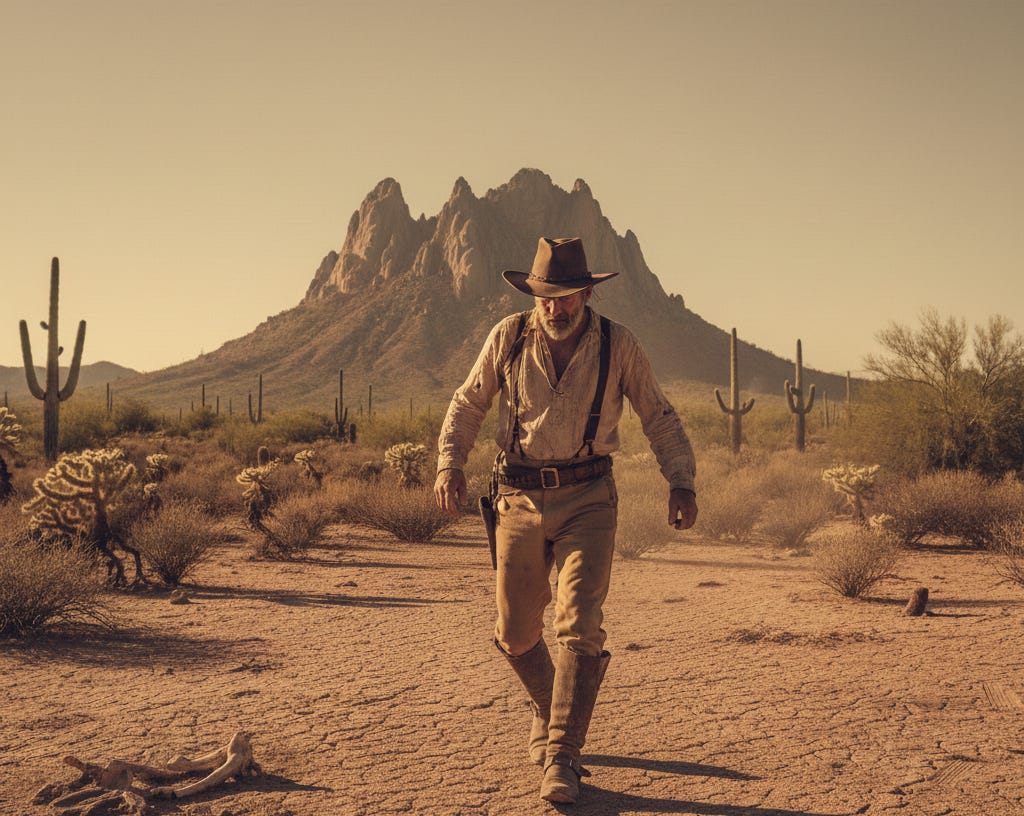
Picacho Peak
A Story Inspired by the Song
The gold was gone.
Walter Koenig stood swaying in the Arizona sun, his empty hands hanging at his sides like dead things. Somewhere behind him—half a mile back, maybe more, he’d lost all sense of distance—lay twelve pounds of raw gold scattered across the desert floor. He’d dropped it when his knees had buckled, when his body had finally overruled his fevered mind, and he hadn’t had the strength to pick it back up.
Now the sack lay back there among the creosote and brittlebush, probably half-buried already by the relentless wind that pushed sand into every crevice of this godforsaken land. Twelve pounds of gold, worth more than most men saw in a lifetime, just sitting there for the javelinas to nose at and the ravens to investigate.
Walter didn’t look back. He couldn’t. Every ounce of will he possessed was focused on the jagged silhouette that rose from the desert floor some miles ahead—Picacho Peak, that ancient volcanic spire the Spanish had named “Peak Peak” in their redundant way. Beyond it, if he could get there before sundown, the Butterfield road ran toward Tucson. The evening stage would be making its run.
If he could just reach it.
His lips cracked and bled when he tried to wet them with a tongue like dried leather. The canteen on his shoulder swung light as a promise, empty since morning. He’d taken the last drop an hour ago—a single warm bead of water that had done nothing but remind him how desperately thirsty he was. He’d thrown the canteen away after that, not wanting its mocking weight, but somehow it had stayed on his shoulder, bouncing against his hip with each stumbling step.
Three Days Earlier
He’d been crossing through the hills northwest of Tucson, making his way toward Yuma on business that had seemed so urgent just a week ago. The route he’d chosen cut through rough country—volcanic remnants and basalt flows from some ancient eruption that had left the land scarred with black rock formations rising like frozen waves from the desert floor.
He hadn’t been looking for gold. Walter Koenig was a businessman, not a prospector. He’d come to Arizona Territory to establish a mercantile operation, not to scrabble in the dirt like the thousands of wild-eyed men who’d flooded into these hills over the years, chasing rumors and dying of thirst for their troubles.
But when he’d stopped to let his pack donkey rest in the shade of an overhanging basalt shelf, something had caught his eye. A glint in the black rock. A thread of yellow running through a crack in the ancient volcanic stone, barely visible unless you were standing in exactly the right spot at exactly the right time of day, when the sun struck it just so.
Gold. Raw, native gold, threaded through quartz in a narrow vein that some ancient cataclysm had deposited in this black volcanic remnant and then hidden for millennia.
Walter’s heart had hammered in his chest. He knew enough about mineralogy to recognize what he was seeing—knew enough, too, to understand that such finds were rare, that veins like this were typically narrow and shallow, easily exhausted. But in that moment, reason had abandoned him. The fever had taken hold.
He’d started digging immediately, using his belt knife and bare hands at first, then finding loose stones to chip away at the quartz. The vein was thin, barely two inches at its widest, but the gold was pure and plentiful within it, coming away in nuggets and flakes that he gathered into his canvas sack with trembling fingers.
All day he dug. All night by the light of his small fire. The next morning he dug again, following the vein deeper into the rock face, hacking and scraping until his hands bled and his shoulders screamed for rest.
He didn’t notice when his donkey wandered off, probably seeking the water that Walter had forgotten to provide. By the time he realized the animal was gone—taking with it his spare water and most of his supplies—the creature was nowhere to be seen. His canteen was nearly empty. The vein was nearly exhausted. And he was alone in a sea of rock and sand, twenty miles from anything that could be called civilization.
The Morning He Left
“Don’t go,” Martha had said.
She’d stood in the doorway of their little adobe house on Meyer Street, her hands twisted in her apron, her dark eyes bright with worry. Behind her, the Tucson morning was coming alive—the calls of Mexican vendors, the creak of wagon wheels on the unpaved street, the distant bark of dogs in the barrio.
“It’s dangerous country, Walter. The Apaches—”
“Geronimo surrendered years ago,” he’d said, checking the straps on his pack. “The Indian wars are over.”
“There are still raiding parties. And even without Indians—if you get hurt out there, if something happens...” Her voice had broken. “There’ll be no one to help you.”
He remembered how he’d crossed the room to her, had taken her face in his hands. “I have business in Yuma, Martha. That shipment won’t wait forever. Henderson’s already got another buyer lined up—if I don’t get there soon, we lose everything we’ve invested.”
“Then let it go. We’ll find another way.”
But he hadn’t let it go. Couldn’t let it go. He’d kissed her forehead, had promised to be careful, had walked out the door with his pack donkey trailing behind him. And when he’d turned back at the corner of the street, she’d still been standing in the doorway, her face wet with tears, one hand raised in farewell.
Now, stumbling through the desert with his prize abandoned behind him, Walter wondered if he’d ever see that doorway again. Ever feel Martha’s hands on his face, her lips against his cheek. Ever sit in the small courtyard behind their house and watch the sunset paint the Santa Catalina Mountains in shades of rose and gold.
The Telegram
The telegram had arrived three weeks ago, delivered by a boy from the Western Union office on Congress Street. Walter had been working on the accounts in the back room of Tully and Ochoa’s mercantile, where he’d taken a temporary position while trying to establish his own business.
KOENIG STOP BUYER WAITING FOR HARDWARE SHIPMENT STOP WILL SELL TO JENSEN IF NO PAYMENT BY MONTH END STOP FINAL NOTICE STOP HENDERSON YUMA
The hardware shipment. Picks, shovels, pans, sluice boxes—everything a prospector needed, ordered from suppliers in San Francisco and shipped to Henderson’s warehouse in Yuma. Walter had put a deposit on the lot six months ago, planning to open a supply store in Tucson to serve the steady stream of miners still working the hills around the territory. It was to be the foundation of his new life, his stake in this raw young land.
But the balance was due, and his funds had run short. The trip to Yuma was supposed to deliver the payment and secure the shipment.
Now, of course, none of that mattered. He’d found gold enough to buy ten such shipments, and then lost it all to his own stubborn foolishness. Henderson had probably already sold his goods to Jensen. And Walter Koenig would be lucky if he lived to see another sunset.
The Desert
The rattlesnake didn’t move as Walter stumbled past.
It lay coiled in the shade of a barrel cactus, its diamond-patterned scales blending perfectly with the sandy soil. Walter saw it from the corner of his eye—saw the flat triangular head, the thick body, the telltale rattle at the tip of its tail. The snake’s forked tongue flickered, tasting the air, tasting him.
He didn’t stop. Didn’t flinch. Didn’t alter his shuffling course by so much as an inch. The rattler watched him pass with its cold, unblinking eyes, but made no move to strike. Perhaps it recognized a creature already dying. Perhaps it simply couldn’t be bothered. In this heat, even the predators conserved their energy.
Walter kept walking.
A quarter mile on, movement in the brush brought him up short. A javelina—what the Mexicans called a “jabalí”—stood in a gap between two palo verde trees, its coarse gray fur bristling, its small eyes fixed on the stumbling human. The pig-like creature was easily sixty pounds of muscle and tusk, and Walter had heard stories of what a charging javelina could do to a man.
He stared at the beast. The beast stared back.
“Go on,” Walter croaked, the words scraping his raw throat like broken glass. “I’ve got nothing for you.”
The javelina snorted once, then turned and crashed away through the brush, its hooves clicking on the rocky ground. Walter watched it go, then resumed his shambling march toward the peak.
He didn’t see the mesquite tree until he was almost under it. A rare gift in this barren stretch—a spreading umbrella of feathery green leaves offering shade from the hammering sun. Walter collapsed beneath it, his back against the twisted trunk, his legs splayed out before him like a marionette whose strings had been cut.
Just for a moment, he told himself. Just a moment’s rest.
The sting was like a hot nail driven into his ankle.
Walter jerked upright with a strangled cry, his hand flying to his leg. The scorpion skittered away into the leaf litter—pale, almost translucent, its segmented tail still curved in threat. An Arizona bark scorpion, the most venomous of its kind. He’d sat down right beside its hiding spot.
The pain radiated up his leg in waves, turning the flesh hot and tight. His foot began to tingle, then to numb. Walter gritted his teeth and forced himself to stand. He couldn’t stay here. Couldn’t rest. The sting would make the next hours harder, but it wouldn’t kill him—probably—and staying still meant dying for certain.
He lurched forward, limping now, the sting adding its fire to the symphony of pain that had become his constant companion.
The jumping cholla got him an hour later.
He’d been weaving between the cacti, too focused on Picacho Peak to watch where he was placing his feet. The teddy-bear cholla—so named for its fuzzy appearance, though there was nothing cuddly about it—stood waist-high in his path. He brushed against it without thinking.
The segment detached at the barest touch, embedding itself in his thigh. A dozen barbed spines drove through the fabric of his trousers and into his flesh, each one hooked so cunningly that pulling only drove them deeper.
Walter howled—a dry, cracked sound more animal than human. He dropped to his knees and used his belt knife to pry the segment loose, leaving bloody holes in his leg and tears in his trousers. More segments had attached to his shirt sleeve, his boot, his hat where it had fallen. He picked them off one by one, leaving his fingers studded with tiny spines that would fester for days.
If he lived that long.
The bobcat appeared sometime in the afternoon, though Walter had lost all sense of time. He glimpsed it on a rocky outcrop above—a tawny shape with tufted ears, watching him with the patient attention of a born predator. It followed him for miles, sometimes visible, sometimes not, always keeping its distance.
Waiting, Walter thought dimly. Waiting to see if I fall.
He stumbled into a wash without seeing it—a dry streambed that cut across his path, its banks steep and sandy. He slid down one side and climbed up the other, then stood swaying at the top, trying to orient himself.
The sun was wrong.
He’d been walking toward the peak, but now the peak was... where? Behind him? No—to his right. Somehow, in the wash, he’d gotten turned around. He’d been walking the wrong way, away from salvation, deeper into the desert.
“No,” he whispered. Then, louder: “No!”
He turned and began walking again, toward the peak now, always toward the peak. His shadow stretched long before him, pointing east. The sun was sinking. Time was running out.
The Stagecoach
By the time Walter reached Picacho Peak, the sky had turned copper, bleeding into shades of purple and black. Stars were beginning to appear, cold and distant, like the gold flakes he’d scattered across the desert floor.
The peak rose before him like a jagged promise, its volcanic spire black against the darkening sky. Somewhere on the other side, the Butterfield road wound its way between Tucson and points north. The evening stage would be making its run.
But which way around the peak? Left or right? The delirium that had been nibbling at the edges of his consciousness now threatened to consume him entirely. The rocks seemed to move when he looked at them. The saguaros appeared to walk. Voices whispered in the wind—Martha’s voice, his mother’s voice, voices of people long dead.
Left, he decided. Or maybe right. He chose a direction and began to walk, circling the base of the peak, his feet moving by some animal instinct that had outlasted his rational mind.
He heard the stagecoach before he saw it. The jingle of harness, the creak of leather springs, the rhythmic thunder of hooves. He crested a small rise and there it was—a Concord coach, its varnished sides gleaming in the last light, six horses straining in their traces as the driver urged them toward the way station ahead.
“Wait!” The word came out as a croak, inaudible over the noise of the coach. Walter tried to run, his legs churning in the loose sand, his arms waving.
His boot caught on a rock. He pitched forward, his hands flying out to break his fall. His face struck the ground with a jarring impact that loosened teeth and split his lip. His hat flew off and rolled away into the scrub.
He lay there for a moment, tasting blood, feeling two of his front teeth shift sickeningly in their sockets. Then, with a groan that seemed to come from somewhere deeper than his body, he pushed himself up.
The coach was moving away. The driver hadn’t seen him. In moments it would round the curve and be gone, carrying his last hope of survival with it.
Walter found his feet. He found his voice—or some remnant of it. He began to stagger after the coach, waving his bloody hands, making sounds that might have been words.
The shotgun messenger saw him first. A shout, a pointing arm. The driver hauled on the reins, bringing the team to a snorting, stamping halt. Faces appeared in the coach windows—passengers, their expressions shifting from annoyance to alarm as they took in the shambling figure emerging from the desert dusk.
“Lord almighty,” someone breathed.
Walter reached the coach and collapsed against its wheel, his legs finally giving out. The driver climbed down, followed by the messenger. Hands reached for him, grasped him, hauled him upright.
“Water,” he gasped. “Please.”
Someone pressed a canteen to his cracked lips. He drank greedily, choking, water running down his chin and mixing with the blood from his split lip. The sensation was so intense it was almost painful—the shock of moisture in his parched body, the cool slide of it down his ravaged throat.
“Tucson,” he managed between gulps. “Need to get to Tucson.”
“That’s where we’re headed, mister,” the driver said, his weathered face creased with concern. “But the coach is full up. Nine passengers inside already, packed like sardines.”
“The roof,” Walter said. “I’ll ride on the roof.”
They helped him up, half-carrying him to the back of the coach where a iron ladder led to the luggage rack on top. He climbed with hands that no longer seemed to belong to him, his fingers finding rungs by feel rather than sight. At the top, he collapsed among the trunks and valises, his face pressed against the rough canvas of a mail sack.
“You sure about this?” the messenger called up. “It’s a rough ride.”
Walter’s answer was to pull a length of rope from the baggage and begin lashing himself to the luggage rack. He tied knots with fingers that had gone numb, securing himself as best he could against the inevitable jostling of the journey.
The whip cracked. The horses lunged forward. And Walter Koenig closed his eyes as the Concord coach carried him south toward Tucson, toward Martha, toward home.
Tucson
The coach rolled into Tucson just after midnight, its wheels clattering over the unpaved streets of the old pueblo. Lamps burned in the windows of Congress Street—the saloons and gambling halls that never slept—and the sounds of laughter and music drifted through the warm night air.
Walter didn’t stir when the coach stopped in front of the Palace Hotel. He’d passed beyond exhaustion into some deeper state, his body shutting down to conserve what little life remained. The ropes he’d tied around himself were the only thing keeping him from sliding off the roof.
“Got a dead man up here,” one of the porters announced, peering up at the motionless figure lashed to the luggage.
“He ain’t dead,” the messenger said, though he didn’t sound certain. “Was talking when we picked him up. Desert rat, near as I can tell. Found him wandering near Picacho.”
They cut the ropes and lowered him down, handling his limp body like a sack of grain. His skin was hot and dry to the touch, his breathing shallow, his pulse threadly and weak. The broken teeth showed dark against his cracked lips. Cholla spines still studded his clothes and skin.
“Take him to the horse trough,” someone suggested. “Cool him down.”
They carried him around the corner to where a wooden trough stood in front of the livery stable, its water dark and still in the moonlight. Without ceremony, they dumped him in.
The shock of the water—cool, clean, impossibly wet—brought Walter gasping back to something like consciousness. He thrashed weakly, his hands gripping the rough wooden sides of the trough, his face barely above the surface. But he lacked the strength to climb out, and after a moment he simply lay there, floating, letting the water soak into his dehydrated flesh.
A horse wandered over and dipped its muzzle into the trough, drinking placidly beside Walter’s head. Then another. The livery stable’s morning watering had begun, and no one seemed inclined to fish the half-dead stranger out of the animals’ drinking water.
“Who is that?” a passing drunk asked, squinting at the figure in the trough.
“Some fool who came in on the stage,” a porter replied. “Found him near Picacho, more dead than alive.”
The drunk peered closer, then let out a bark of recognition. “Hell, I know him! That’s Koenig—the fellow what works for Tully and Ochoa. His wife lives over on Meyer Street.” He straightened up, already turning away. “Someone ought to tell her that her drunk fool of a husband is embarrassing himself and her down in front of the saloon.”
Martha
Martha came running.
She came in her nightgown, her hair unbound and streaming behind her, her bare feet slapping against the packed earth of the street. She came with tears already on her face, though whether from fear or relief or simple exhaustion, even she couldn’t have said.
She found him in the horse trough, floating among the hay stalks and horse slobber, his eyes half-open and unfocused. For one terrible moment she thought he was dead. Then he turned his head at the sound of her voice, and something like recognition flickered in his gaze.
“Martha.”
“Oh, you fool,” she whispered, reaching into the water to cup his face in her hands. “You absolute fool.”
She got him out of the trough with the help of some men who’d gathered to watch. She got him home, half-carrying him through the dark streets to their little adobe house. She got him into bed, stripped off his ruined clothes, cleaned his wounds, extracted the cholla spines that still peppered his skin.
And through it all, Walter talked. Words spilled out of him in a fever-driven rush—the gold, the discovery, the obsession that had consumed him. The donkey wandering off. The endless march through the desert. The rattlesnake, the javelina, the scorpion, the cholla. The stagecoach appearing like a miracle against the darkening sky.
“The gold,” he kept saying. “I lost the gold. Had it in my hands and I lost it.”
“Hush,” Martha said, pressing a cool cloth to his forehead. “Rest now.”
“The shipment too. Henderson’s already sold it. Everything we planned—”
“It doesn’t matter.”
“But the store, our future—”
“Walter.” Her voice was firm now, cutting through his delirium. She took his face in her hands again, forcing him to meet her eyes. “You came back. That’s all that matters. You came back to me.”
He stared at her for a long moment. Then something in him broke—some wall he’d built around his heart to keep himself moving through the desert—and the tears came. They rolled down his sunburned cheeks and soaked into the pillow beneath his head, and Martha held him while he wept.
“I dropped my gold,” he whispered. “I dropped my pride. I left it all out there in that desert.”
“And you made it home,” she said. “That’s the only treasure that matters.”
Outside the window, the first light of dawn was touching the Catalina Mountains, painting them in shades of rose and gold. The sounds of Tucson waking drifted through the shutters—roosters crowing, dogs barking, the first vendors calling their wares in the streets.
Walter closed his eyes. For the first time in days, the fever of gold had left him. In its place was something else—something simpler, warmer, more precious than any yellow metal hauled from the black rock of an ancient volcano.
He felt human again.
Lyrics
Picacho Peak
[Verse 1] It was dry and hot in that Arizona desert, Cacti far as any man could see, My canteen hung light, just swingin’ on my shoulder, My tongue like leather, lips split and bleed.
[Verse 2] Water was a memory by then, Each step kicked up one more little ghost of dust, Rattlers buzzed a warning, Javelinas watched from the brush, But they didn’t want a piece of me, not that day.
[Chorus] Picacho Peak, you jagged little promise, Standin’ there, just smirkin’ in the heat, I dropped my gold, I dropped my pride, Spit out blood and swallowed every mile between, I left it all out in that desert, But I made it, To Picacho Peak.
[Verse 3] Stage coach rolled by there, once every evening, Headed on down the road to Tucson town, And all I could hear was wagon wheels in my heartbeat, Tickin’ like a clock sayin’, “Sun’s goin’ down”, So I plodded on, boots chewed to the leather, Hat brim low, but my eyes locked on that rock, If I could touch that trail by nightfall, I’d trade this whole cursed haul for one last drop.
[Chorus]
[Bridge] Sky turned copper, then it bled out black, Stars lit up like the gold in my sack,That I dropped back there, somewhere in the sand, Funny what you’ll trade just to feel human again.
[Chorus]


